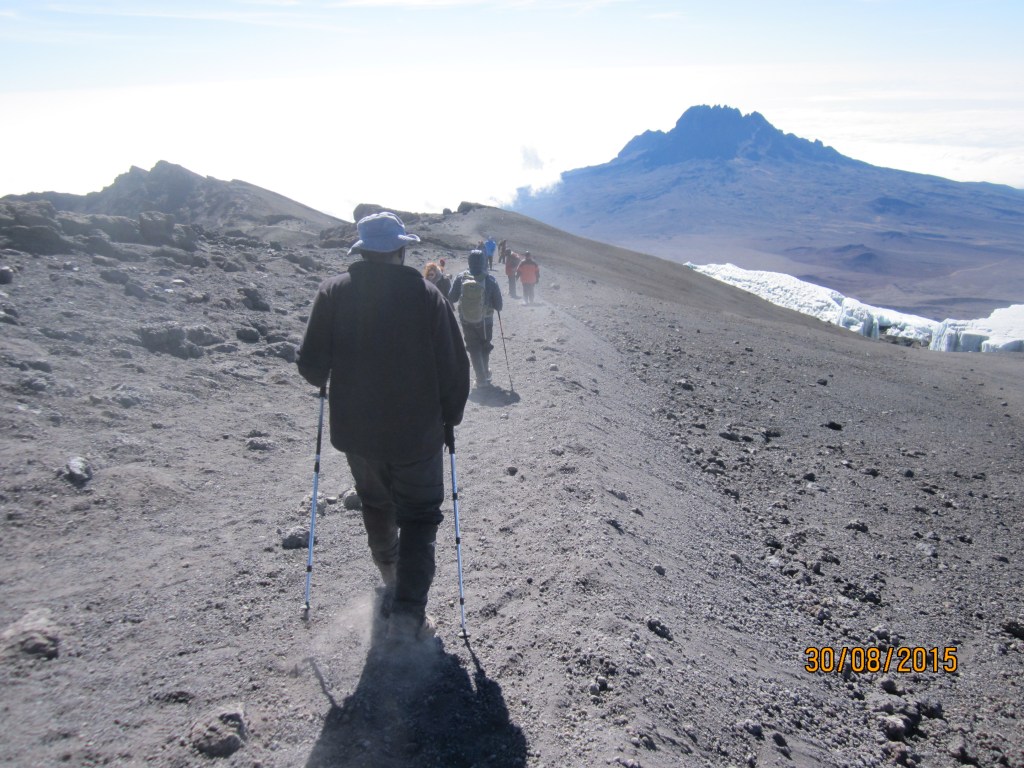
The mountains cleareth my mind.
What’s the best time to climb?
Some key factors that influence the best time to climb are the temperatures, the rainy season & avoiding crowds.
The best time to climb Kilimanjaro is during warmer months and when it’s not raining: which tends to be December to February and July to October. However, that is a busy time on the mountains as well. Our climbs – which were during the busy times – had a long line of people waiting to get past some tricky points such as the Barranco wall as well as the summit night.
One other consideration is activities that one needs to do before or after the climb. One popular activity is hitting a safari after the climb (assuming one has enough vacation, moolah and energy levels remaining). The Great Migration is a fantastic treat for all the wildlife lovers and not to be missed. From that perspective, the best time for a safari is during the dry season from late June to October. So for folks looking to couple the 2 activities, July through October is a good time to target.
Which tour company should I use?
Hiking with a good tour company is one of the key decisions for a great hike. At a high level, one can either hike with local operators (who tend to be cheaper) or finding operators closer to you (ex: US/UK based who tend to be costlier). The international operators tend to be costlier but offer end to end planning including airline reservations and related logistics.
Some key drivers of picking a good tour company are: price, safety/trust, success rates (though not as publicly shared), other activities being offered, convenience of picking any dates you want, cancellation policy, what routes they offer etc. Trip Advisor is always good to look up reviews for safety/trust while other information can be obtained by discussing with the companies. For Safety related questions: You also want to enquire how frequently they check your health stats (ex: Oxygen levels in blood using Oximeter), their evacuation policies, ratio of porters etc. Also you may be interested in knowing whether
Some operators that are normally recommended are: Altezza (bit pricier but can customize routes), Local Moshi Adventures, & Kilipeak Adventures, Monkey Adventures.
What route do you recommend?
There are multiple routes for the summit – all of which culminate towards the summit. Some key factors that should influence the route selection: number of days for the route (more days gives you more time to acclimatize but may not be feasible for people with shorter vacations or know they can handle high altitudes from other treks like EBC), distance covered, scenic nature of the route.
Our personal favorite is the Lemosho route which takes 7-8 days and offers pretty sights along the way (with a rain forest on the way). Another recommended routes are Northern Circuit (one of the longer ones that takes 9 days and gives more time to acclimatize).
How do I get there?
JRO airport (in Arusha) is the closest airport for Kili. It is a relatively small airport – with old style luggage handlers. However, it is well connected by multiple international airlines.
Some key airlines that fly into JRO are KLM, Qatar airways, Ethiopian airlines, Air Kenya – which results in different price points. Ethiopian and Qatar had some of the better pricing for folks flying from the US – with layovers in Addis Ababa and Doha respectively.
What are visa requirements?
Most foreign visitors are required to obtain a visa for entry into Tanzania. The visa doesn’t always need to be obtained prior to arrival as they can be issued at the port of entry. However, in order to avoid passport delays or risk of loss in transit, we preferred the port of entry option personally.
Visitors from some countries don’t need a visa for entry, however, citizens of US, UK, Australia, Canada, India need a visa.
For the visa on arrival for US and EU citizens, you only need your passport (make sure it is valid for at least 6 months from your date of departure), visa form that you get on the plane (make sure a pen is handy) and $50 (EU citizens) or $100 (for US citizens). You don’t need to bother bringing a picture since the immigration officer takes it along with your fingerprints.
Please check for PCR test requirements since those have been changing over the past couple of years.
Note that yellow fever certification may be needed if you are coming from certain countries – but doesn’t apply if you are coming from US or EU.
Make sure you check the guidelines here.
What is the ballpark expense for the trip?
The classic reply – would be – It depends. It depends on what kind of tour company one picks, where is one flying from, what options does one pick with the tour company etc.
However, to provide a general idea: for someone flying from eastern US, flight tickets would be around $1500-$2000, tour company expense for hiking can be $2000-$3000 while tips & other expenses can be ~$500. So you want to budget around at least $5k-$6k for the trip. It can add up if you add activities after the trip – such as a safari or flying to Zanzibar (which has some fantastic beaches).
What should my exercise regimen be?
You need to be in relatively good shape to climb the mountain. The 2 key things for a successful climb are: good physical fitness & altitude acclimatization.
In order to get physically fit, we recommend at least 3-4 months of prep time (for someone starting from relatively scratch). You should schedule at least 10 hikes that are 4+ hours traversing 8-10 miles and climbing with a daypack and has 3k feet of altitudes changes. If that is not accessible, make sure you are using the stairmaster (30 minutes for 3 times a week) along with working your cardio (target running 5ks in 35 minutes of 10ks in 70 minutes) or so. One controversial recommendation is to use the elevation training high altitude mask. It is not clearly proven that these work but a few of us practiced with these on during our practice hikes and our oxygen levels remain elevated throughout the hike.
And how do I acclimatize?
One good recommendation is to know how your body reacts to high altitudes. In order to check how our body reacts, a few of climbed some 14kers in the Rockies (check out the blog on Quandary Peak) that gave us a better sense of how our body would react to the high altitudes. If you don’t do well on these hikes, then it may not be advisable to climb Mt Kilimanjaro.
A standard prescription for most of us living at sea level is to take diamox to help with altitude acclimatization. You are supposed to take it the day before you get to a higher elevation (read that as day before your climb). Some people may have adverse reaction to diamox – so we recommend that you take it for a day or two during your prep and actually do a decent hike – in order to know how your body reacts to it. If your side effect is limited to frequent urination (those pee bottles were handy at night), then you should be good. You can stop taking it once you begin your descent.
Also there are some concerns about taking diamox with anti-malaria medication. There are not much bugs once you are at high altitudes. So you can do take diamox during the ascend and then switch to anti-malaria medication once you are off diamox.
Some people also took dexamethasone the day before the summit to help your body further – but please consult your doctor.
For a successful climb, it is important to climb slowly (pole-pole), drink plenty of fluids, eat well, try to sleep well and listen to your guides.
 Outdoors4Life